A thermal power plant produces electric power of 600 kW at 4000 V, which is to be transported to a place 20 km away from the power plant for consumers' usage. It can be transported either directly with a cable of large current carrying capacity or by using a combination of step-up and step-down transformers at the two ends. The drawback of the direct transmission is the large energy dissipation. In the method using transformers, the dissipation is much smaller. In this method, a step-up transformer is used at the plant side so that the current is reduced to a smaller value. At the consumers' end, a step-down transformer is used to supply power to the consumers at the specified lower voltage. It is reasonable to assume that the power cable is purely resistive and the transformers are ideal with a power factor unity. All the currents and voltages mentioned are rms values.
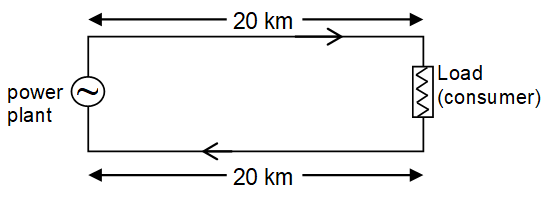
(i) If the direct transmission method with a cable of resistance 0.4 Ω Ω km –1 is used, the power dissipation (in %) during transmission is
Text Solution
Verified by Experts(i) Sol; (ii) Sol
Ans
(i)
Sol. P = 600 × 1000 = 4000 × I ⇒ I = 150 A
Power loss = I 2 r = (150) 2 × 0.4 ×20 × 2 = 360kW
Power loss percentage =  ×100 =
⇒ 60 %
(ii)
Sol.  =
= 
Prepare Smarter with CGP Edu
Get practice questions, solutions, and test series in one place.
Write a Review
Share your experience with this question and solution.
Commentary
Send your comment, doubt, correction, or feedback to admin.
Similar Questions
Explore conceptually related problems